- AI Contact Center Leaders Digest
- Posts
- What's Keeping Contact Center Leaders Awake?
What's Keeping Contact Center Leaders Awake?
Not like what you are thinking.

Bruce Vo
April 03, 2025
Contact center leaders across industries face a common challenge today. They recognize AI's transformative potential, but the implementation path feels fraught with risk and uncertainty.
After 20+ conversations with Communication and Customer Service Directors, three consistent concerns emerged:
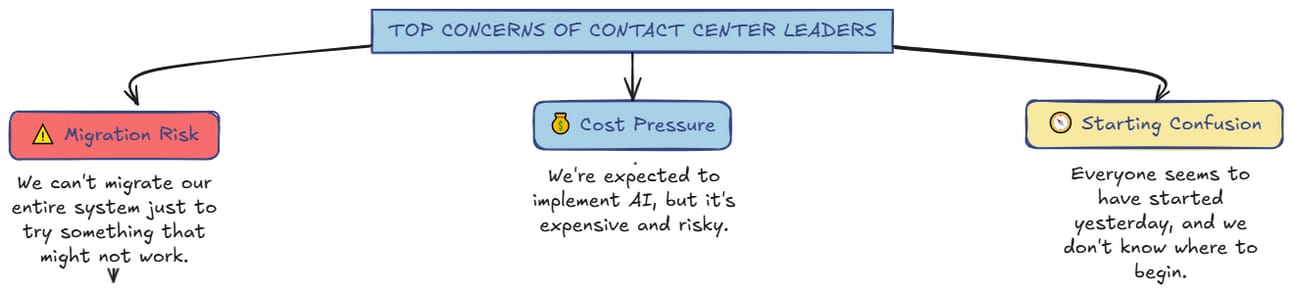
Migration risk: "We are under pressure to apply AI to optimize the processes. But it’s Expensive and Risky."
Cost pressure: "We're expected to implement AI, but it's expensive and risky."
Starting confusion: "Everyone seems to have started yesterday, and we don't know where to begin."
These aren't isolated concerns. They represent the genuine dilemma facing leaders tasked with modernizing customer experiences while maintaining operational stability.
The Three Implementation Paths (And Why Most Fail)
Contact center leaders typically consider three approaches:
Full platform migration to solutions like Verint or AXP: Effective when you're ready for complete ecosystem integration, but risky as a first step.
Building custom solutions in-house: Provides control but demands significant time, engineering talent, and budget (typically 2-3 months for even small processes).
Piloting with plug-in products and expert services: Allows testing AI capabilities within a controlled scope while delivering immediate ROI.
Our projects over the past 2 years show that the third approach delivers the best outcomes for initial AI implementation at this AI phase. Why? Because it addresses all three core concerns simultaneously.
The Formula for Low-Risk, High-Visibility AI Implementation
The most successful contact center transformations share a common formula: start with a well-scoped, high-visibility process that demonstrates clear ROI without disrupting existing operations.
Great implementation follows these principles:
Target scoped-processes directly impacting critical metrics: Choose areas affecting CSAT scores, agent handling times, or operational costs.
Leverage plug-in applications that integrate with existing systems: Avoid replacement and migration by augmenting what already works.
Secure success with expert guidance: AI implementation involves complex considerations and customization, from data preparation to agent training, that benefit from experienced oversight. An out-of-the-box solution rarely works.
Knowledge Base Accessibility: The Perfect Entry Point
Knowledge base accessibility consistently proves to be the most effective first AI implementation for contact centers.
Why? Because it directly addresses measurable operational challenges:
Average time agents spend querying information during calls
The learning curve for new agents mastering product, industry knowledge
The efficiency of knowledge base growth and maintenance
A well-executed AI knowledge solution delivers:
Chat-based access to previously scattered information
Suggested real-time answers during customer interactions
Automatic knowledge base expansion from successful interactions
All should be done without requiring the replacement of existing systems or processes.

Moving Forward with Confidence
The path to AI transformation doesn't require betting the entire operation on unproven technology. Start with a targeted, well-scoped implementation that delivers visible results while minimizing risk.
We are considering on a series where we'll break down the five most effective entry points for AI in contact centers, complete with implementation timelines and expected ROI metrics.
Your contact center deserves AI that solves real problems, not creates new ones.